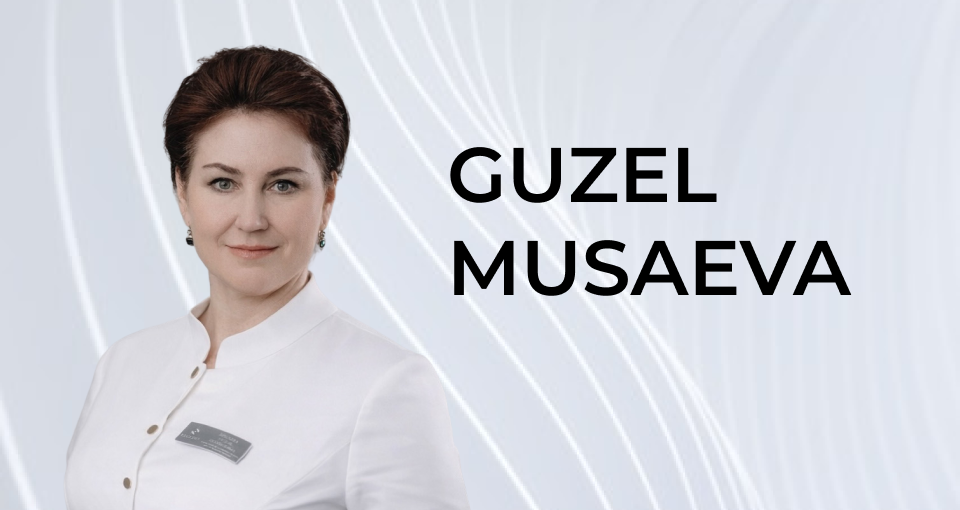
Guzel Musaeva has spent her career doing what most physicians don’t: moving between frontline medicine, executive leadership, teaching, and policy — without fully leaving any of them behind. This conversation is about what clinical judgment really asks of you—and what, over time, can quietly wear it down.
You worked as a hospital orderly as a schoolgirl, and your sister was a physician. Did medicine ever feel like a choice, or more like inevitability?
Both, in a way. Everything pointed in one direction, but I didn’t want to simply arrive—I wanted to feel that I had earned my place. So I enrolled in a physics and mathematics program to prepare for the entrance exams. The path was clear; I just wanted to be ready for it.
Your university had an anatomical theater dating back to 1814. Does that kind of history actually shape you, or is it just atmosphere?
It does shape you—though not in an obvious way. No one sits you down and explains it. You simply absorb it over time. You study in a space where generations of physicians studied before you. You begin to feel that continuity. Kazan State Medical University was founded in 1814 as part of the Imperial University. Lenin studied there. Lobachevsky—the mathematician who reimagined geometry—served as its rector. Vishnevsky developed infiltration anesthesia within those walls. Darkshevich described the nucleus that still carries his name. And Zavoisky first observed electron paramagnetic resonance there—the discovery that would later become the physical foundation of MRI. These aren’t portraits in a hallway. They’re the institution’s actual DNA. Kazan also has one of the oldest and most beautiful anatomical theaters in Russia—and I studied in it. When you dissect in a place like that, you’re not just learning anatomy. You feel that you’re stepping into something that existed long before you. It doesn’t feel like pride. It feels more like responsibility. A quiet sense that the standard is already there—and you’re expected to live up to it.
When did it stop being theory?
Fourth year. A two-year-old in clinical death. I was doing shifts at a children’s hospital. In Russia, medical students can work as nursing staff after completing the required coursework. One July day, a call came in: a two-year-old, unconscious after a routine vaccination, being brought in from a daycare center. We prepared the resuscitation room. A specialist arrived quickly. The child had already lost vital functions. What I saw, I have never forgotten. The resuscitator worked with complete precision—clear commands, no raised voice, no visible panic. That calmness carried through the entire room. Our doctor and I assisted. When the boy was revived, the relief was almost overwhelming. At the end, the physician thanked us and shook my hand. After that, I began placing IV lines in newborns—in their tiny hands, sometimes in the veins of their heads. Even now, it’s hard to believe I did those things.
When you place an IV line in a newborn’s scalp vein—is there a moment you stop being a student? Something does shift. Your hands begin to know what to do, sometimes before your mind catches up. But that still doesn’t make you a physician. It isn’t the diploma. It isn’t finishing residency. It happens more quietly. You see it when a patient looks at you with real trust—not because they have no choice, but because they believe you understand. And when you make a difficult diagnosis on your own, and see that your decision actually helps—that it works. Even then, it’s not something you finish. You keep becoming a physician over time. You learn to treat not just the disease, but the person—their history, their fears, their way of understanding what’s happening to them. And you learn to doubt.
You’ve said doubt is a professional skill. That’s not how most people think about it.
Because most people use the word differently. They confuse doubt with uncertainty, but they’re not the same. The most dangerous moment in medicine isn’t when you don’t know something. It’s when everything feels obvious—when you’re certain you have the answer. That’s when you risk turning off the internal question that should always be there. Am I missing something? Have I really seen the whole picture? The human body isn’t static. It adapts, reacts, behaves differently—even when everything seems to match the textbook. Early on, you think that with enough experience, mistakes will disappear. But the opposite happens. The more you learn, the more clearly you see how much remains unknown. And that doesn’t weaken medicine. It’s what keeps it honest. Doubt isn’t a weakness. It’s a skill you learn to rely on.
There’s a story you’ve told about a patient in your nephrology ward…
He was 33, an oil worker. He had traveled more than 2,500 miles because there was no dialysis where he lived. End-stage kidney disease. When he arrived, he was almost joyful. He had made it. He believed he would be treated. That he would survive. The hospital needed a payment guarantee from his employer before starting dialysis. Over two days, his condition worsened. The approval came for the next morning. That morning, he died.
How do you carry something like that?
You don’t fully carry it. He came all that distance to live. And in the end, a bureaucratic delay made everything we could do as physicians irrelevant. There’s a boundary in medicine. One part is yours—your decisions, your timing, your judgment. And then there’s another part shaped by systems, policies, and money. I understood that before. But after him, I felt it in a way that stayed with me. You learn to be precise about what is yours to carry—not because it makes it easier, but because without that clarity, you can’t keep working.
You use AI tools in your practice. Where do you see the real risk—not the obvious one?
The obvious risk is error. AI can be wrong—I’ve seen that myself. It doesn’t carry responsibility, and it doesn’t feel the clinical context the way a physician does. But the deeper risk is quieter. When something gives you a fast, confident answer, it can create the sense that thinking is no longer necessary. Over time, you can begin to rely on that external certainty instead of your own reasoning. And if you lose the habit of sitting with uncertainty—of working through it—that’s when clinical judgment starts to fade. AI can quietly erode it.
Patients now arrive with printed ChatGPT diagnoses. What’s your first instinct?
At first, it felt disruptive. A patient coming in with screenshots could feel like a challenge. Now I see it differently. A patient who searches—even if the information isn’t reliable—is trying to understand, to take part in what’s happening to them. That’s not a problem. That’s engagement. And engagement is where good medicine begins.
So what do you do with the printout?
We go through it together. We talk about what makes sense, what doesn’t, and why. Often, those conversations lead somewhere more precise—sometimes even to something unexpected. AI doesn’t remove doubt. If anything, it gives us more space for it. Digital medicine is not a replacement for the physician. It is a physician who has become stronger. But only if they continue to think.
And after all these years—has anything become easier?
Some things do. But you don’t become more certain. You learn to stay with uncertainty—and to work with it more carefully. And in a way, that’s what allows you to keep going.
Discover more from Doctor Trusted
Subscribe to get the latest posts sent to your email.