
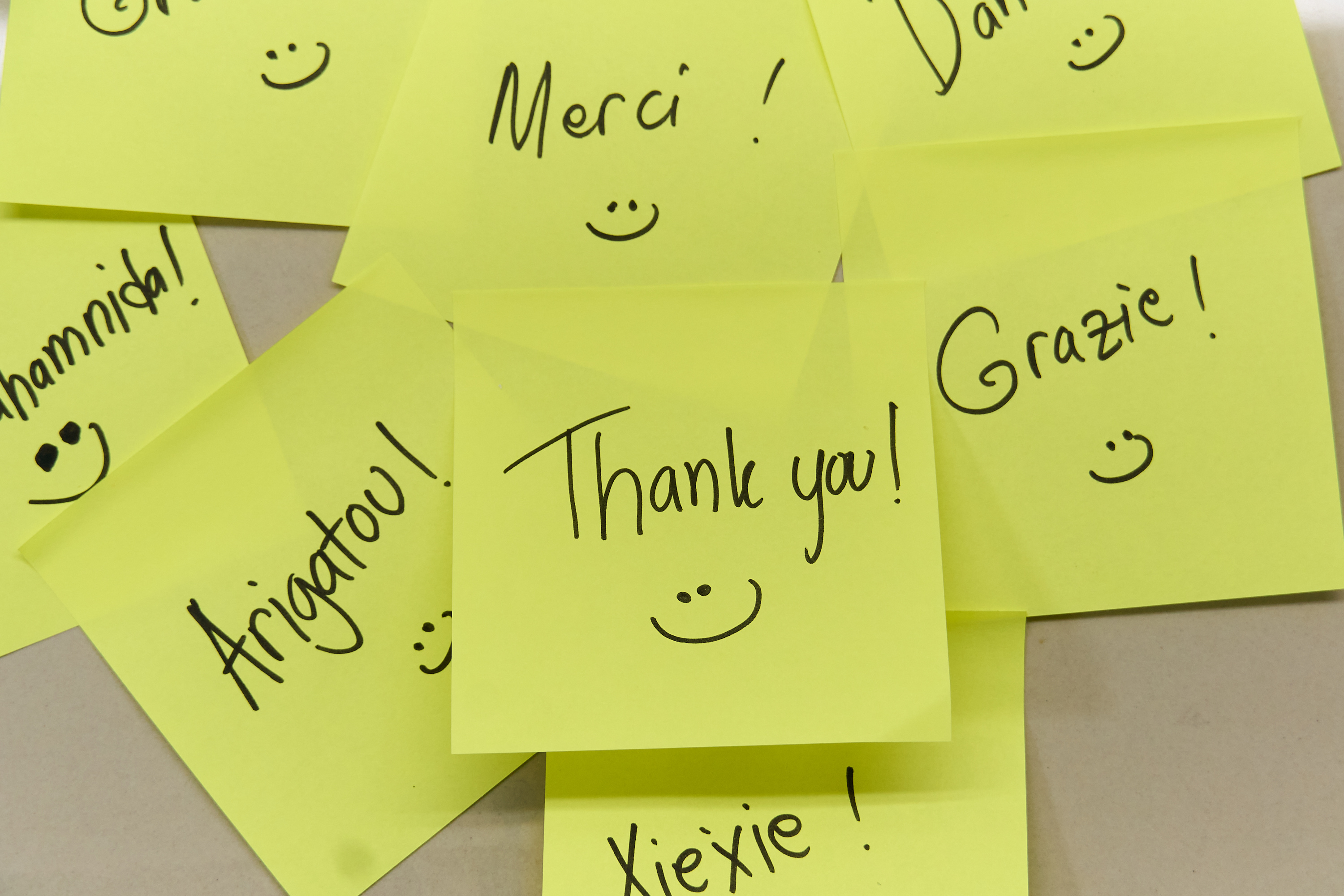
Thanksgiving is on November 26. Before the season of heartfelt posts begins, a skeptic’s guide to what thankfulness can do for doctors and patients, and what it cannot.
By Iryna Tetera, Editor in Chief, WCH Insights
Picture a Tuesday afternoon in clinic. You are forty minutes behind. The EHR has just informed you that a note is “incomplete” in a way it declines to specify. A colleague leans into the doorway and suggests, with the serene confidence of a person who has recently attended a wellness seminar, that you try writing down three things you are grateful for.
You consider your options. Most of them involve the stapler. Your reaction is understandable, and, as it happens, partly correct. But it is also worth a look at the data, because gratitude practice is one of those rare wellness ideas that has been tested often enough to disappoint us in some detail and surprise us in others.
The Origin Story Is a Good One
The technique everyone cites is called Three Good Things, and it is exactly what it sounds like. Each evening you record three things that went well and, ideally, why. In the study that made it famous, Seligman and colleagues randomized 577 adults to do this for a single week, and reported higher happiness and lower depression at one month, with results holding at three and six months.
One week of homework, six months of effect. If that were a drug, it would already have a jingle.
Then the Meta-Analysis Arrived
Then came the pooled data, which have the temperament of a good attending: polite, thorough, and unmoved by enthusiasm. A meta-analysis of 27 studies found a small effect of gratitude interventions on depression and anxiety, both right after the intervention (g = −0.29) and at follow-up (g = −0.23). The effect looked bigger when gratitude was compared with a waitlist than when it was compared with another activity, which is to say, part of the benefit may come simply from being asked to do something at all. The authors’ advice to people with real depression and anxiety was to choose interventions with stronger evidence.
Translation: for a patient with clinical depression, “be more grateful” belongs in the category of advice that is kind, free, and not a treatment.
What Happens When You Ask Clinicians to Try It
Health care workers have been studied too, with results best described as cautiously charming.
In one randomized trial, 223 faculty, trainees and staff in a family medicine department received text-message prompts three times a week asking for three things they were grateful for. It was cheap, easy, and well liked, and it lifted mood. By month three, though, the gains in depression and gratitude had mostly faded and were no longer significant. Gratitude, it turns out, behaves like a gym membership: the effect depends on continued attendance.
Then there is the study of general surgery residents, which deserves a plaque. Overall, gratitude and job crafting did not differ in their effect on burnout. But among residents who started out at high risk of burnout, scores improved, while among those who started at low risk they went the wrong way. Make people who are doing fine write about their blessings on command, and some of them will find the assignment itself to be a new source of stress. Forced gratitude, like forced fun, has a way of producing its opposite.
Other, weaker studies are friendlier. Uncontrolled cohorts of health care workers using Three Good Things, a gratitude letter, and a “looking forward” exercise reported improvements that the authors described as promising for burnout. An older randomized trial of a twice-weekly gratitude journal in medical workers found lower self-reported depressive symptoms and perceived stress. Promising is a word researchers use when they would like more funding and do not want to overclaim. It is a respectable word.
The Patient with the Notebook
The most intriguing patient data come from cardiology. In a pilot trial, 70 patients with Stage B (asymptomatic) heart failure were randomized to eight weeks of gratitude journaling or usual care. The investigators reported lower levels of several inflammatory biomarkers and higher heart rate variability while the patients wrote. It is a lovely finding, and its authors were careful about it, noting that large studies with active control conditions are needed to confirm it. Elsewhere in the literature, the picture is mixed: gratitude-inducing writing had no direct effect on inflammatory markers in healthy middle-aged women.
So the honest summary is that gratitude journaling is a low-risk adjunct that some patients may find useful. It is not yet a cardiac intervention, and nobody should stop the beta-blocker in favor of a notebook.
The Inconvenient Adult in the Room
Here is the part that matters most, and it is not about gratitude at all.
A meta-analysis of controlled burnout interventions in physicians found small but significant reductions overall, with larger effects for organization-directed approaches (SMD −0.45) than for physician-directed ones (SMD −0.18). The authors drew the conclusion that burnout belongs to the whole health care organization, not to individual doctors. Most of the organizational interventions that worked were not inspirational. They were things like lighter workloads and better schedules. In other words, a hospital that responds to understaffing with a gratitude journal has not solved a problem. It has sent a stationery order. Gratitude works best as a companion to repairs, never as a substitute.
How to Actually Use It
What follows are my suggestions, drawn from the studies above, not guidelines from any society.
For yourself. Try Three Good Things for a few weeks, in the format from the family medicine trial: a brief prompt a few times a week, not a daily ritual that becomes one more item on the list. Write one gratitude letter to the colleague who covered your pager or the mentor who never got a proper thank-you. If you are truly depleted or depressed, skip the notebook and see a clinician.
For your team. Put one specific thank-you into the end-of-week meeting. “Thanks for the great work” is wallpaper; “thanks for staying until the transfer was done, it meant the night shift started clean” is a sentence a person remembers. Keep it voluntary, for the reason the surgical residents taught us. And attach it to something real: if the team has told you what is broken, fix one thing before you hand out the compliments.
For patients. Offer it as an optional self-help tool for those who like the idea, especially in rehabilitation and chronic illness, and describe the heart failure study honestly, as a pilot. Do not offer it in place of therapy or medication for depression or anxiety. And mind the calendar: for patients who are grieving, lonely, or short of money, Thanksgiving can be a hard holiday, and a prompt to “be thankful” can land like a reprimand. “What has helped you this week?” asks the same question with better manners.
Gratitude practice, then, is a small and decent tool. It lifts mood a little, costs almost nothing, does no harm to most people who try it, and does a good deal less than the posters promise. That is a perfectly respectable résumé. Plenty of things in medicine have gotten by on less.
So on the 26th, eat the turkey. Thank the people who earned it, by name, and say what they did. Then on Monday, go and fix the schedule.
Sources
- Gold KJ et al., “‘Three Good Things’ Digital Intervention Among Health Care Workers: A Randomized Controlled Trial,” Annals of Family Medicine, 2023 (summary): https://www.news-medical.net/news/20230524/Digital-version-of-a-positive-psychology-intervention-tested-among-health-care-workers.aspx
- Healio, “Practicing gratitude with a ‘feasible and fun’ intervention may reduce physician burnout,” June 1, 2023: https://cm.healio.com/news/primary-care/20230601/practicing-gratitude-with-a-feasible-and-fun-intervention-may-reduce-physician-burnout
- Cregg DR, Cheavens JS, “Gratitude Interventions: Effective Self-help? A Meta-analysis of the Impact on Symptoms of Depression and Anxiety,” Journal of Happiness Studies, 2021: https://springerlink.bibliotecabuap.elogim.com/content/pdf/10.1007/s10902-020-00236-6.pdf
- Adair KC, Kennedy LA, Sexton JB, “Three Good Tools,” Journal of Positive Psychology, 2020: https://pubmed.ncbi.nlm.nih.gov/34295357/
- Multi-institutional trial of gratitude and job crafting in general surgery residents: https://springerlink.bibliotecabuap.elogim.com/content/pdf/10.1007/s44186-023-00100-0.pdf
- OJIN, “Gratitude Practice to Decrease Stress and Burnout in Acute-Care Health Professionals” (review citing Seligman et al., 2005): https://ojin.nursingworld.org/globalassets/ojin/tableofcontents/vol-28-2023/no3-sep-2023/gratitude-practice-to-decrease-stress-and-burnout-in-acute-care-health-professionals_ojin.pdf
- Redwine LS et al., “Pilot Randomized Study of a Gratitude Journaling Intervention on Heart Rate Variability and Inflammatory Biomarkers in Patients With Stage B Heart Failure,” Psychosomatic Medicine, 2016: https://escholarship.org/uc/item/6td9t4r6
- ScienceDaily, “Gratitude and heart failure”: https://www.sciencedaily.com/releases/2015/04/150409093940.htm
- Frontiers in Psychology, review of gratitude interventions and cardiovascular outcomes: https://pmc.ncbi.nlm.nih.gov/articles/PMC10551131/
- Panagioti M et al., “Controlled Interventions to Reduce Burnout in Physicians,” JAMA Internal Medicine, 2017: https://spcr.nihr.ac.uk/publications/physician-burnout-interventions/
Discover more from Doctor Trusted
Subscribe to get the latest posts sent to your email.