
By Elena Pak, Credentialing Department, WCH
The federal government’s semiannual report card on healthcare fraud just landed, and the numbers tell two stories at once — one about enforcement, one about where the enforcement money is actually flowing from.
The Headline Figures
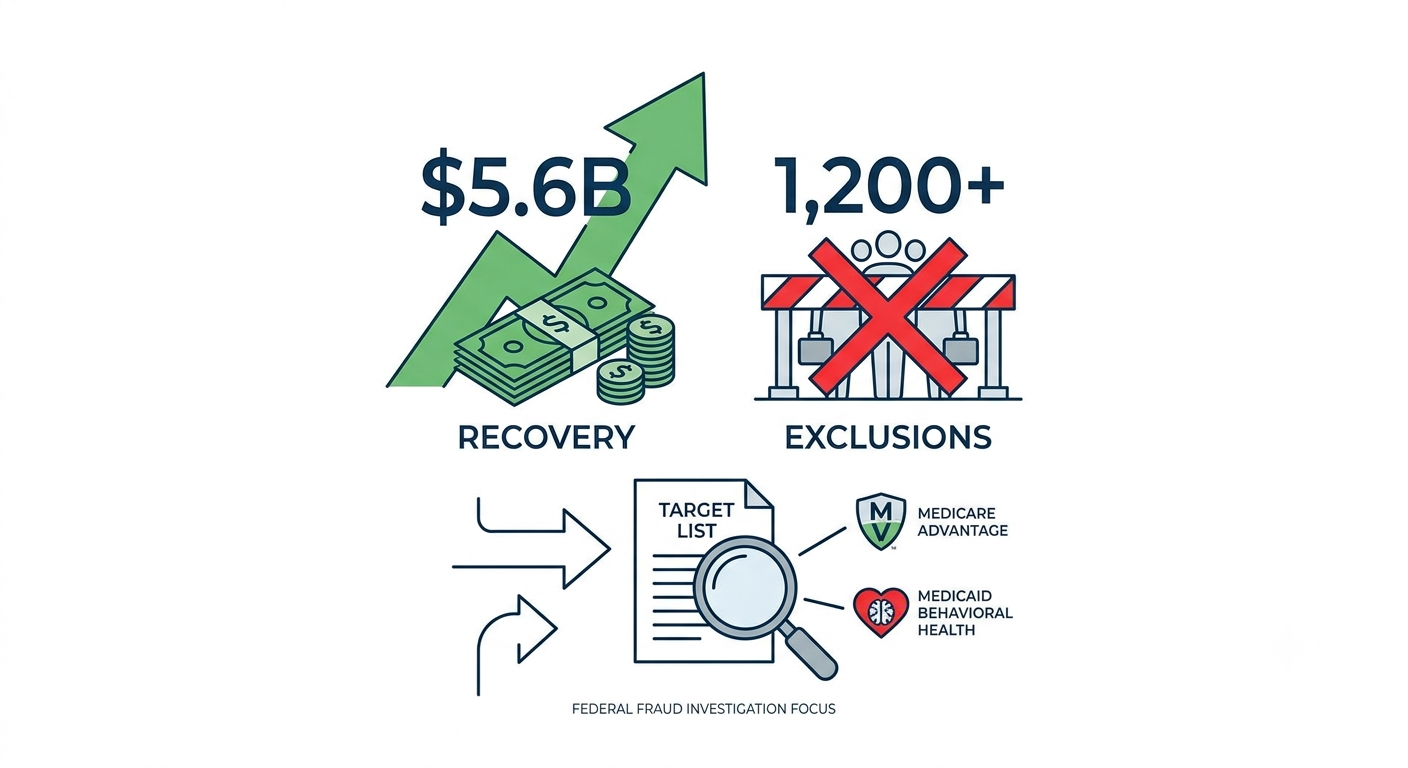
Between October 2025 and March 2026, the HHS Office of Inspector General generated roughly $5.6 billion in monetary impact from fraud, waste, and abuse work across federal health programs. Over that same window, the agency removed more than 1,200 people and entities from federal health programs entirely. The report — required by law every six months and delivered to Congress as the Semiannual Report — lays out the administration’s stated enforcement priorities in plain terms: Medicaid and Medicare Advantage, specifically.
Those are big numbers, but big numbers in an OIG report are the norm, not the exception. What’s worth paying attention to is where the enforcement energy is actually concentrated, because it doesn’t match evenly across the programs OIG oversees.
Three Fronts, One Administration
Front one: telemarketing and DME fraud. The report flags a Medicare telemarketing scheme built around a company called Power Mobility Doctor Rx, whose CEO is now serving a 15-year prison sentence tied to a $1 billion fraud conspiracy. That’s a legacy-style fraud pattern — false billing dressed up as durable medical equipment sales — and it’s the kind of case OIG has pursued for years regardless of administration.
Front two: Medicaid behavioral health. A mother-and-daughter operation in Maryland was ordered to pay more than $3.6 billion — actually $3.6 million — for billing Medicaid for behavioral care services that were never delivered. More significant than the dollar figure is the category: Medicaid is explicitly labeled a “top OIG priority” in this report, and applied behavior analysis (ABA) billing for autism services gets called out by name. That’s not incidental. ABA clinics have grown explosively over the past decade, and reporting this year — from both the New York Times and the Wall Street Journal — has already documented overbilling concerns and the strain these claims are putting on state Medicaid budgets. OIG naming this sector specifically signals where the next wave of enforcement actions is likely to land.
Front three: Medicare Advantage settlements. This is the one MA plan compliance officers should read twice. The report cites two settlements finalized earlier this year: Kaiser Permanente affiliates paying $556 million, and Aetna paying $117.7 million, both to resolve allegations of defrauding the Medicare Advantage program. These aren’t small regional plans — they’re two of the largest names in the MA market, settling nine-figure-plus allegations within months of each other.
The Part That Doesn’t Add Up Cleanly
Here’s where the report gets genuinely interesting, and where a purely enforcement-focused reading misses the real story.
At the same time OIG is naming Medicare Advantage a top fraud target and touting nine-figure settlements against two of the biggest MA players, CMS has finalized higher payment rates to MA insurers for the coming year — sending billions of dollars more into the program even as independent researchers and analysts continue to flag outsized MA spending as a factor that could accelerate Medicare’s insolvency timeline.
Put those two facts side by side and you get an administration simultaneously prosecuting MA plans for fraud and increasing the size of the pool those same plans get paid from. That’s not necessarily a contradiction — a program can be both overpaid at the policy level and defrauded at the claims level, and fixing one doesn’t fix the other. But it does mean the “war on fraud” framing, which is how the administration has publicly branded this enforcement push, is doing more rhetorical work than structural work. Recovering $674 million combined from Kaiser and Aetna is real money. It is also a rounding error against a Medicare Advantage program that costs the federal government tens of billions more per year than paying for the same beneficiaries under Traditional Medicare would.
Medicaid Is Where the Politics Get Sharper
The Medicaid side of this report can’t be separated from the broader funding fights happening in parallel. The same administration issuing this fraud report has also halted hundreds of millions of dollars in Medicaid funding to Democrat-led states — California, New York, and Minnesota among them — citing fraud concerns, and has gone as far as decertifying and defunding state Medicaid fraud units in Hawaii and New York for what it called insufficient enforcement.
Layer on top of that the first-ever national Medicaid work requirement, which the administration has explicitly framed as an anti-fraud, anti-waste measure, and a pattern becomes visible: fraud enforcement language is being used as the justification for a set of funding and eligibility changes that go well beyond individual bad actors getting prosecuted. Several states have already sued over the work requirement rules, arguing the practical effect will be eligible people losing coverage over paperwork, not fraud recovery. States have until 2027 to begin enforcement, so this fight has a while to run.
None of that makes the underlying fraud cases in this report less real. The Maryland ABA case and the Power Mobility Doctor Rx conviction are legitimate, documented fraud with named defendants and court outcomes. But it means readers — especially compliance officers at state Medicaid agencies and MA plans — need to separate two different things happening under one banner: individual enforcement actions against specific bad actors, and a broader policy campaign using fraud rhetoric to justify funding cuts and eligibility restrictions.
What This Means If You Run Compliance for a Payer or ABA Provider
A few concrete takeaways, by sector:
If you’re a Medicare Advantage plan: The Kaiser and Aetna settlements are not abstractions — they establish a template OIG is comfortable using again. If your organization has any open questions about risk-adjustment coding practices, home-visit diagnosis capture, or documentation supporting HCC codes, this is the moment to close those gaps proactively, not after a subpoena arrives. Settlement size in both cases suggests OIG is willing to pursue MA fraud cases at a scale that makes “we’ll deal with it if it comes up” a bad strategy.
If you run an ABA or autism therapy provider: You are now a named category in a federal enforcement report, not an incidental mention. Billing documentation, session-note specificity, and medical necessity justification for ABA hours should be audited internally before a state Medicaid program or OIG does it for you. The reporting from national outlets on overbilling in this space means investigators already have a map of where to look.
If you administer state Medicaid programs: The funding-freeze and decertification actions against Hawaii, New York, and Minnesota show that “insufficient fraud enforcement” is now a lever the federal government is willing to pull against state program integrity units directly, not just against individual providers. States should assume their own fraud unit’s performance metrics are under federal review, independent of any specific case activity.
For everyone tracking this space: Read every future OIG Semiannual Report against the funding and rate decisions happening in the same window. The enforcement numbers alone will always look impressive. Whether they represent a serious dent in program spending, or a much smaller recovery running alongside much larger rate increases, is the question that actually matters — and it’s one this report answers only if you read the CMS side of the ledger alongside it.
Sources
- Halleman, Sydney. “HHS watchdog says it’s targeting Medicaid, Medicare Advantage fraud.” Healthcare Dive, July 13, 2026. https://www.healthcaredive.com/news/hhs-watchdog-focused-fraud-medicaid-medicare-advantage-enforcement-oig/825034/
- HHS Office of Inspector General. “Semiannual Report to Congress, Spring 2026.” https://oig.hhs.gov/documents/sar/11794/Spring_2026_SAR.pdf
- U.S. Department of Justice. “CEO of Health Care Software Company Sentenced in $1B Fraud Conspiracy.” https://www.justice.gov/opa/pr/ceo-health-care-software-company-sentenced-1b-fraud-conspiracy
- The New York Times. “Autism Clinics Investigation.” May 23, 2026. https://www.nytimes.com/2026/05/23/health/autisim-clinics-investigation.html
- The Wall Street Journal. “Autism Therapy Insurance Bills.” https://www.wsj.com/health/healthcare/autism-therapy-insurance-bills-880b9dba
- The White House. “Trump Administration’s Full-Scale War on Fraud.” May 2026. https://www.whitehouse.gov/releases/2026/05/trump-administrations-full-scale-war-on-fraud/
- Healthcare Dive. “Trump administration halts over $259M in Medicaid funds to Minnesota.” February 26, 2026. https://www.healthcaredive.com/news/trump-administration-halts-over-259m-in-medicaid-funds-to-minnesota/813182/
- Healthcare Dive. “States sue Trump administration over Medicaid work requirements rule.” https://www.healthcaredive.com/news/states-sue-trump-administration-medicaid-work-requirements-rule/824060/
- Healthcare Dive. “Kaiser affiliates to pay $556M to resolve Medicare Advantage fraud allegations.” January 15, 2026. https://www.healthcaredive.com/news/kaiser-affiliates-to-pay-556m-to-resolve-medicare-advantage-fraud-allegati/809716/
- Healthcare Dive. “CVS to pay $118M to settle Medicare Advantage fraud allegations.” March 11, 2026. https://www.healthcaredive.com/news/cvs-medicare-advantage-fraud-doj-settlement/814453/
- Healthcare Dive. “CMS finalizes higher Medicare Advantage rates for 2027.” https://www.healthcaredive.com/news/cms-finalizes-higher-medicare-advantage-rates-2027/816633/
- Healthcare Dive. “Medicare insolvency date, HI Fund, OBBB trustees report.” https://www.healthcaredive.com/news/medicare-insolvency-date-hi-fund-obbb-trustees-report/822499/
Discover more from Doctor Trusted
Subscribe to get the latest posts sent to your email.